How Long Does Caffeine Before Exercise Last? 2026 Study
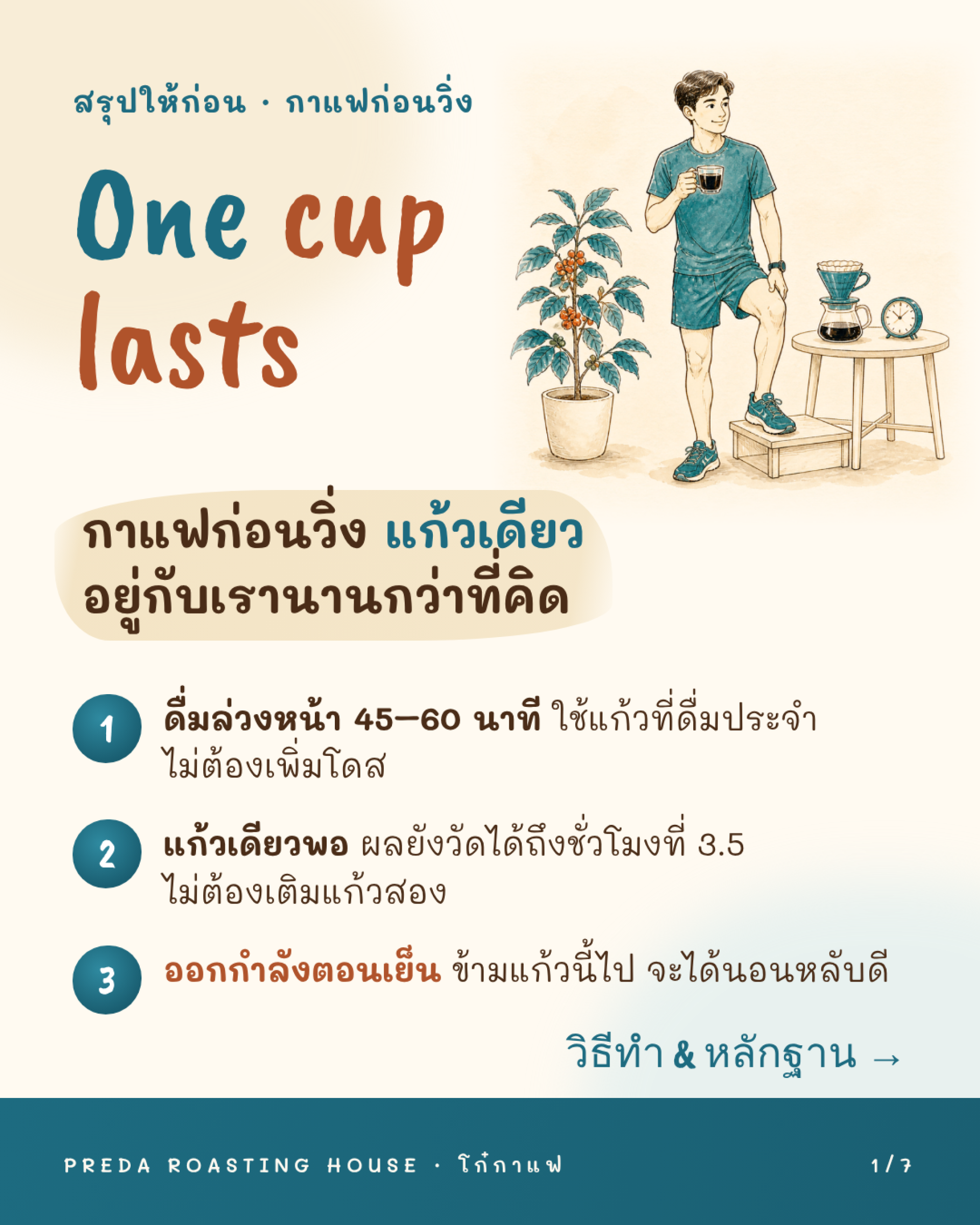
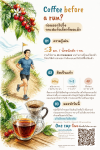
A 2026 University of Tsukuba trial found that a single dose of caffeine taken before exercise kept sprint power slightly above placebo for as long as 3.5 hours. In everyday terms, your usual cup about 4560 minutes before training is enough no top-up needed. The flip side: because the effect lasts, an evening cup may follow you to bed.
An hour into your run, is the morning coffee still working?
Picture a Sunday morning in late October. It is 5:30, you are still half asleep, the kettle is on, and you brew your usual cup of drip coffee, sipping it while you lace your shoes. You head out as the sky starts to lighten. The first kilometres feel easy but close to the one-hour mark a question creeps in: is that coffee still helping, or has it worn off? Should you stop for another?
Late in the year is running season across northern Thailand, so we hear this question a lot. It really has two halves. The first is "how much should I drink?", which Preda covered in "Coffee Before Exercise: One Cup Is Enough" a low dose of roughly one cup already helps. The second is "how long does it last?", and a new trial from Japan answers it quite directly.
How did the Tsukuba researchers run the study, step by step?
The story starts at the University of Tsukuba's Institute of Health and Sport Sciences. Mizuki Nishikawa, Naoto Fujii and colleagues invited 12 healthy young adults (four women, eight men) to the lab on two separate days. On one day they received caffeine at 5.5 mg per kg of body weight; on the other, a placebo. The order was randomized, and neither the participants nor the researchers knew which day was which. The results appeared in Medicine & Science in Sports & Exercise in September 2026.
Each day followed exactly the same sequence. Participants took the caffeine or placebo, then waited about 60 minutes for it to be absorbed. They then got on a bike for the first set: five minutes of easy pedalling, followed by six all-out 5-second sprints. After a rest, they repeated the same routine for a second and a third set three sets in total, spread across 3.5 hours.
Along the way, the team took blood samples for caffeine and noradrenaline, asked participants to rate their effort and leg pain, and measured heart rate, breathing and blood flow to the brain, to track how the body changed over that time.
What happened how far into the session did caffeine keep helping?
Following the timeline, sprint power on the caffeine day was already higher than on the placebo day in the first set, and the gap held through the second and third sets about 0.52.4% higher, still measurable 3.5 hours after ingestion. Peak power improved most in the later sets, two and three, by up to 3.7%. Participants also felt the effort was easier and reported less leg muscle pain.
Why would effort feel easier? As we explained in "Why Does Coffee Wake You Up?", caffeine works like a fake key that takes adenosine's parking spot in the brain adenosine being the signal that tells you you are tired. The "that's enough" message arrives later. The study also found higher blood noradrenaline, consistent with greater arousal.
There is another side to report. On the caffeine day, heart rate was higher and blood velocity in the middle cerebral artery fell during exercise. The authors describe these as accompanying physiological responses without calling them good or bad but they are a reminder that caffeine doesn't come free.
In real life, how is a pre-run coffee like lighting a charcoal stove?
The easiest picture is a charcoal stove. When you first light it, you wait a while for it to get going; once the coals are glowing, it stays warm for hours without more fuel. A pre-exercise coffee follows the same rhythm. The Grzelczyk et al. review (Nutrients 2026) notes that most studies give caffeine about 60 minutes before exercise the "waiting for the coals" stage and the Tsukuba trial suggests the effect then carries on for hours.
Go back to that Sunday morning and the answer is clearer. Brew your usual cup and finish it about 4560 minutes before you leave. Use the wait to warm up, stretch and lace your shoes, then go no need to stop for a second cup on the way. If you brew drip coffee at home, every coffee in Preda's Specialty range drips well; if you prefer it black and iced, an iced Americano made with a medium-roast House Blend such as Fullcity or Simply Sweet is a popular choice. Unsweetened keeps out sugar you don't need.
One exception worth remembering: if you don't normally drink coffee, race day is not the day to start, because you don't know how your body will react. Even in this study, one participant withdrew during the caffeine trial because of symptoms.
If the effect lasts that long, will an evening cup affect sleep?
It can and that is the other side of the same story. Switch the scene to someone who runs after work and drinks a coffee at 6 pm for energy. If the effect lasts three and a half hours, the body is still feeling that caffeine around 9:30 pm, right when bedtime approaches. The stove lit in the evening is still warm when you want to sleep. The Nutrients review notes that afternoon and evening caffeine may delay sleep onset, shorten sleep and change sleep quality.
The Tsukuba study did not measure sleep, but as we covered in "Does Coffee Reduce Deep Sleep?", the body does much of its repair during deep sleep. Evening exercisers may be better off skipping the pre-workout cup and letting sleep do the recovery work.
Before you believe it, what are the study's limitations?
First, size: only 12 people, all healthy young adults. Second, what was tested: pure caffeine at a high 5.5 mg/kg about 330 mg for a 60 kg person, or roughly 34 typical cups of drip coffee (caffeine per cup varies with bean, roast and brewing). It is not a dose to copy.
Third, the exercise: 5-second cycling sprints, not distance running or a marathon. Fourth, the size of the effect: the gains were modest, and most participants were low habitual caffeine users, so results may differ for people who drink several cups a day. Finally, the study did not show that the effect ends at 3.5 hours only that it was still measurable then.
If you have high blood pressure, heart disease, are pregnant or are sensitive to caffeine, check with a doctor before using coffee as a training aid. And if this story fits in one sentence: consistent training and enough sleep help more than any cup. Preda Roasting House and Go+ Café Lampang see coffee as a friend that gets you moving, not the star of the show.
Frequently Asked Questions (FAQ)
Q1. How long before exercise should I drink coffee?
Most studies give caffeine about 60 minutes before exercise. For your usual cup of drip coffee, 4560 minutes ahead works well.
Q2. How long does caffeine help exercise performance?
A 2026 University of Tsukuba trial found a single caffeine dose kept sprint power slightly above placebo for up to 3.5 hours, though it tested only 12 people at a high dose.
Q3. Do I need a second coffee during a long run?
Based on this evidence, no the first dose still works for hours. Topping up mainly raises the risk of jitters, stomach upset and poor sleep.
Q4. Can I drink coffee before an evening workout?
Better to avoid it, because caffeine's effects last for hours and may delay or shorten sleep. Evening exercisers may skip that cup and let sleep support recovery.
Q5. Did the study use actual coffee?
No. It used pure caffeine at 5.5 mg/kg (about 34 cups for a 60 kg person), more than a normal cup, so one coffee may have a smaller effect.
References
- Nishikawa M, Shibasaki M, Fujii N. Pre-Exercise Caffeine Enhances Repeated Sprint Performance and Alters Physiological and Perceptual Responses with Effects Lasting up to 3.5 h. Medicine & Science in Sports & Exercise. 2026 (published ahead of print 1 Sep 2026). doi:10.1249/MSS.0000000000004129
- Grzelczyk J, Ziętala J, Budryn G, Konieczny M, Domaszewski P. Coffee and Physical Performance: What Is Driven by Caffeine and What Is Not. Nutrients. 2026;18(16):2690. doi:10.3390/nu18162690
This article summarizes published research for general information and is not medical advice Preda Roasting House / Go+ Café