Coffee Before Exercise: How Much Caffeine Helps?
How Much Coffee Before Exercise Actually Helps? 2026 Research Says One Cup May Be Enough
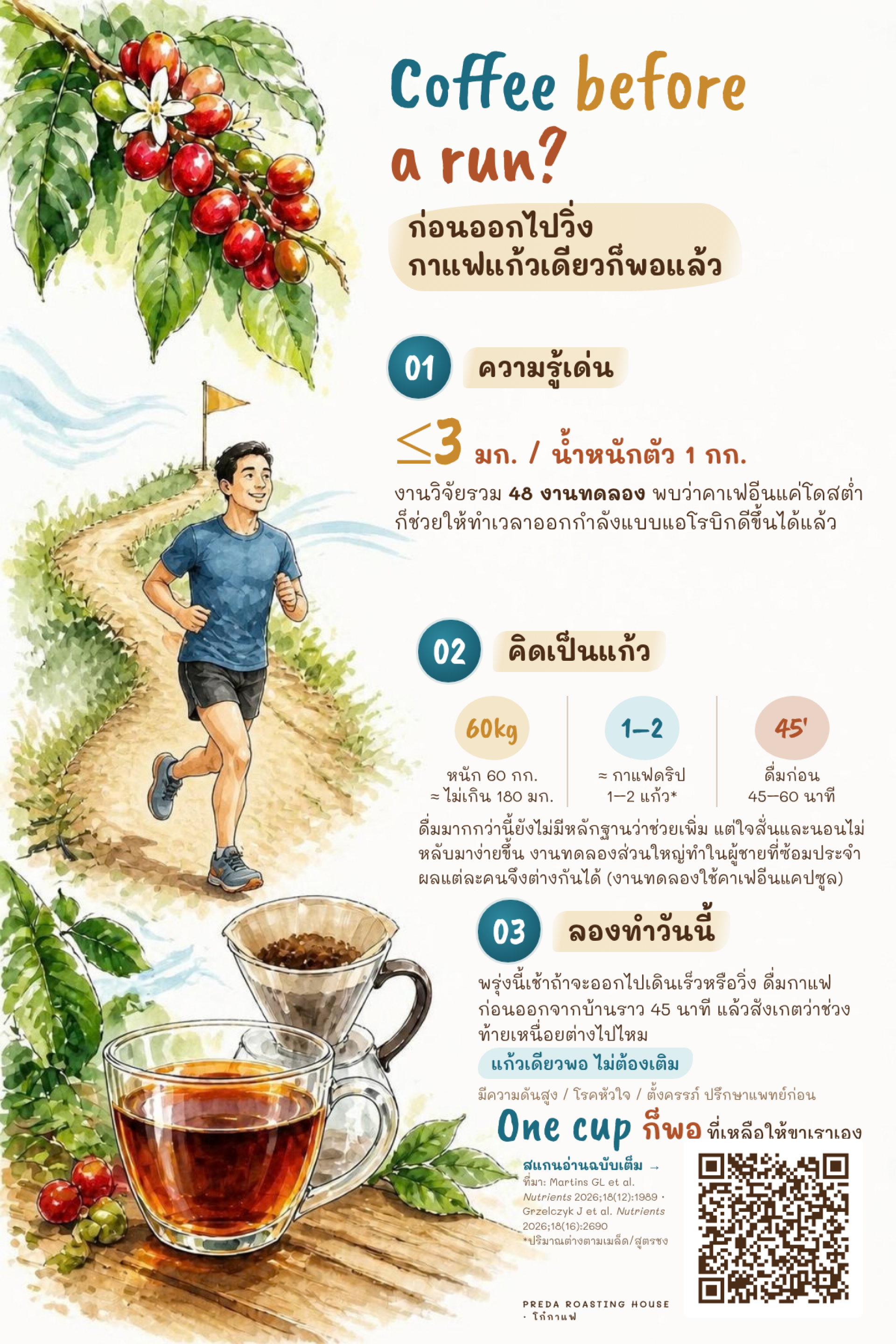
You don't need much. A 2026 meta-analysis of 48 placebo-controlled trials found that a low caffeine dose up to 3 mg per kilogram of body weight, taken 45120 minutes before exercise already improved aerobic time-trial performance. For a 60 kg person, that's roughly one to two cups of drip coffee.
Why does the last kilometer feel easier after a pre-run coffee?
The answer is in your brain, not your legs. As you exercise, a molecule called adenosine builds up and acts like a warning light telling your brain you're tired. As Preda explained in its post on why coffee wakes you up, caffeine works like a fake key that occupies adenosine's receptors first so the warning light comes on later and the same effort feels easier.
A 2026 review in Frontiers in Physiology confirms this is caffeine's main ergogenic mechanism: reducing perceived effort and muscle pain, rather than instantly making muscles stronger.
How much caffeine do you actually need?
Researchers led by the University of São Paulo pooled 48 randomized, placebo-controlled trials (689 participants), mostly cycling and running time trials, published in Nutrients in June 2026. Even a low dose of up to 3 mg/kg significantly improved completion times. A moderate dose of 46 mg/kg produced a larger and more consistent effect, which the authors suggest suits competitive events.
For a 60 kg person, the low dose is up to about 180 mg roughly one to two cups of drip coffee. Caffeine content per cup varies widely with bean, roast, ratio and brew method, so treat this as an estimate.
Is more caffeine better?
There's no evidence for it. The meta-analysis found no eligible time-trial studies above 6 mg/kg, while higher doses make jitters, stomach upset and poor sleep more likely. For everyday exercisers, one cup is a sensible place to start.
Does coffee work the same as caffeine pills?
The trials above used anhydrous caffeine, not coffee. A separate August 2026 Nutrients review, 'Coffee and Physical Performance: What Is Driven by Caffeine and What Is Not', concludes that coffee's performance effects are driven mainly by its caffeine, while compounds like polyphenols and chlorogenic acids may play a 'modulatory rather than ergogenic' role, for example around post-exercise inflammation evidence the authors call limited and largely indirect.
Who should be careful, and when should you drink it?
93% of trial participants were men, mostly trained, and individual responses varied widely partly due to genetic differences in caffeine metabolism (CYP1A2). Take it 45120 minutes before exercise; if you train in the evening, weigh the risk to your sleep, which is when real recovery happens. People with high blood pressure, heart conditions, pregnancy or caffeine sensitivity should check with a doctor first.
How can drip coffee lovers try this?
Brew one cup of unsweetened drip coffee 4560 minutes before your run or ride and notice how the final stretch feels. Preda Roasting House roasts for home drip brewing, from House Blend options like Original Blend to rotating specialty lots and at Goh Café, one drip cup before a workout is plenty.
Frequently Asked Questions (FAQ)
Q1. How long before exercise should I drink coffee?
Most trials gave caffeine 45120 minutes before exercise; 4560 minutes is a practical window.
Q2. How many cups of coffee before a run?
Up to 3 mg of caffeine per kg already helps about one to two cups of drip coffee for a 60 kg person, depending on the brew.
Q3. Is a bigger dose better?
There's no evidence above 6 mg/kg, and side effects like jitters and poor sleep become more likely.
Q4. Does coffee help strength training?
Effects on strength and power are less consistent than for endurance and depend on context and the individual.
Q5. Can people with high blood pressure drink coffee before exercise?
Check with a doctor first, since both caffeine and exercise temporarily raise blood pressure.
References
- Martins GL, Aparecido JM, Marquezi ML, et al. Dose-Response Effect of Oral Caffeine Use on Aerobic Exercise Performance: A Systematic Review and Meta-Analysis. Nutrients 2026;18(12):1989. mdpi.com/2072-6643/18/12/1989
- Grzelczyk J, Ziętala J, Budryn G, Konieczny M, Domaszewski P. Coffee and Physical Performance: What Is Driven by Caffeine and What Is Not. Nutrients 2026;18(16):2690. DOI: 10.3390/nu18162690
- Leng et al. Caffeine and human performance: from molecular mechanisms to exercise and recovery. Frontiers in Physiology 2026;17. frontiersin.org
This article summarizes published research for general information and is not medical advice Preda Roasting House / Go+ Café