Coffee & Depression Risk: How Many Cups Is Ideal?
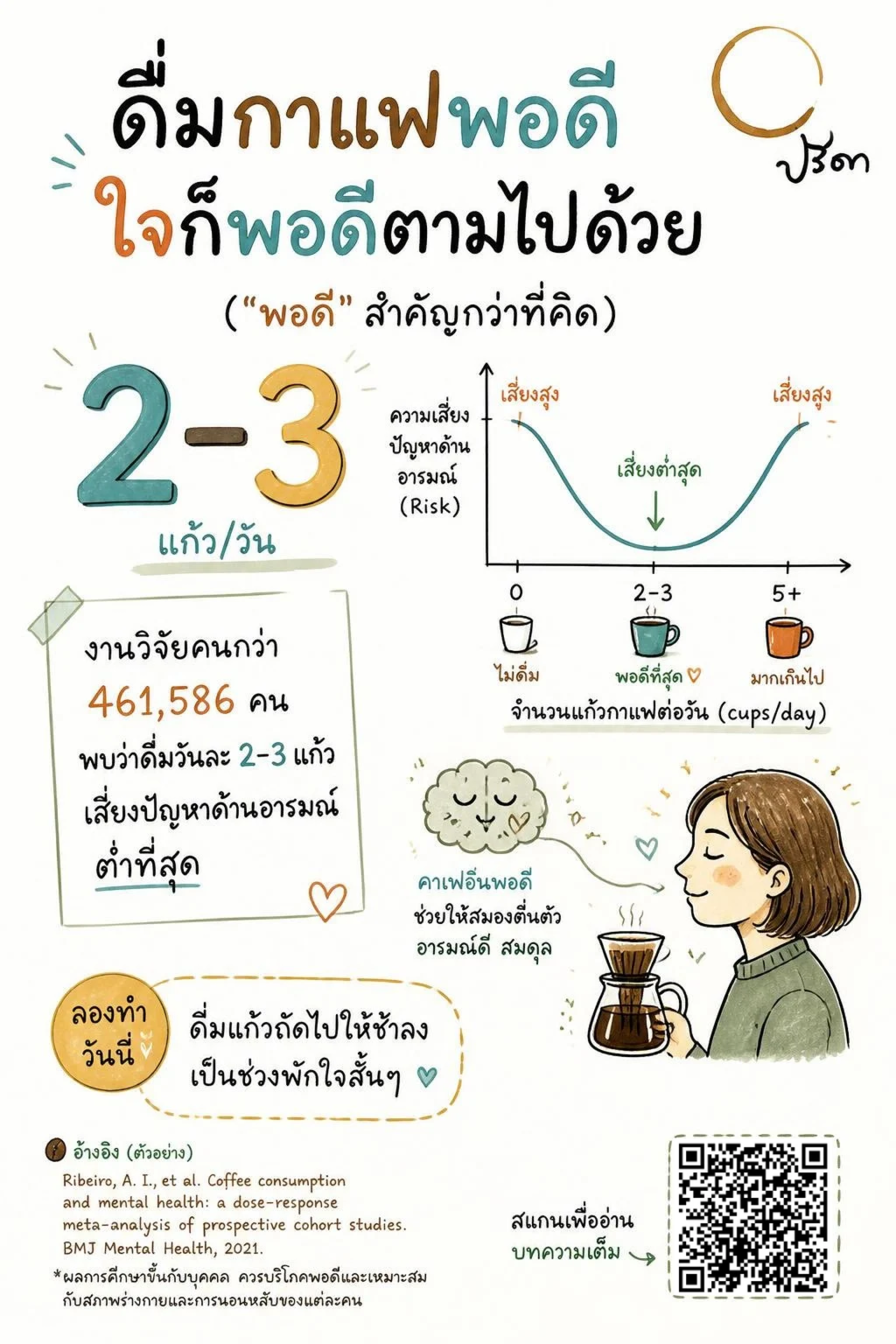
Coffee and Depression/Anxiety Risk: How Many Cups a Day Is Best for Your Mental Health?
A UK Biobank study of 461,586 people followed for a median of 13.4 years found the lowest rates of newly diagnosed mood and stress-related disorders among those drinking 2-3 cups of coffee daily, while non-drinkers and people drinking 5+ cups daily showed higher risk. It is an association, not proof that coffee prevents or treats depression.Does your morning cup really do something for your mood?
Plenty of people feel it: that first cup of coffee seems to make the day feel a little lighter. Researchers at Fudan University in Shanghai set out to test whether that feeling holds up in the data. Using UK Biobank health records for 461,586 people who had no diagnosed mental health condition at the start of the study, they tracked participants for a median of 13.4 years to see who went on to develop a mood disorder or a stress-related disorder. The results were published in the Journal of Affective Disorders.The relationship they found was not a straight line of "more is better" — it was J-shaped, with a sweet spot in the middle.
How many cups a day is best for mental health?
Among the 461,586 participants, people drinking 2-3 cups of coffee a day had the lowest rates of both newly diagnosed mood disorders and stress-related disorders. People who drank no coffee at all had higher risk than the moderate-intake group — which is why researchers describe the pattern as J-shaped: risk drops as intake rises from zero, bottoms out at a moderate amount, then climbs again at higher intake.So why is drinking too much actually worse?
The flip side is that people drinking 5 or more cups a day had higher rates of stress-related disorders than moderate drinkers. That lines up with what many coffee drinkers already notice from experience — too much caffeine can overstimulate the nervous system, showing up as a racing heart, poor sleep, or restlessness. The amount matters just as much as whether you drink coffee at all.Does it have to be drip or ground coffee — why did instant and even decaf show a similar pattern?
Here's what makes this study more interesting than it first appears: the J-shaped pattern showed up at similar strength across ground coffee, instant coffee, and even decaffeinated coffee. That suggests caffeine isn't the only thing doing the work — coffee contains more than a thousand other bioactive compounds, including chlorogenic acid, an anti-inflammatory polyphenol. That's the same family of compounds we covered in our piece on the NR4A1 receptor, where caffeine itself actually bound less consistently than coffee's other polyphenols.Does it matter if someone metabolizes caffeine quickly or slowly?
This is where the study surprised even the research team. People carry different genetic variants that control how fast their body clears caffeine — some metabolize it quickly, others slowly — so you might expect the mental-health association to look different across these groups. But when the researchers split participants by caffeine-metabolism genotype, the J-shaped pattern looked similar in both fast and slow metabolizers. In other words, genetics may decide how long caffeine stays in your system, but it didn't meaningfully change the overall relationship between coffee and mental health risk in this data.Why did the study find a stronger benefit in men than women?
One more finding worth sitting with: the association between moderate coffee intake and lower mood-disorder risk was more pronounced in men than in women. There's no settled explanation yet, but one hypothesis raised is that women tend to metabolize caffeine more slowly on average, and fluctuating estrogen levels across the menstrual cycle or life stage may interact with the nervous system differently than they do in men. This remains a hypothesis that needs further research, not a firm conclusion — it doesn't mean women get no benefit from coffee, just that the effect size observed in this particular dataset was smaller.The mechanism: where does coffee actually touch the nervous system?
The proposed mechanism connects directly to something we've already explained in our piece on why coffee cures sleepiness: caffeine acts like a "fake key" that occupies the brain's receptors for adenosine, the molecule that makes us feel drowsy and fatigued. But there are several adenosine receptor subtypes, and this study points to coffee likely acting on mood through two of them at once — activating A1 receptors, which can produce antidepressant-like effects, while blocking A2A receptors, which are linked to stress-induced dysfunction in the nervous system. Combined with the anti-inflammatory effects of coffee's other compounds, this dual mechanism may help explain why both caffeinated and decaf coffee showed a similar directional pattern.How much should we actually take away from this?
The key caveat is that this is observational research — it shows that coffee-drinking habits and mental health risk are associated, not that coffee directly causes the difference. The UK Biobank sample also skews heavily toward white adults aged 40-69 in less-deprived parts of the UK, so the findings may not translate directly to a Thai population. Coffee habits were also self-reported at a single point in time, despite more than a decade of follow-up. A separate literature review in Nutrients makes the same caution explicit: caffeine should not be treated as an antidepressant, since positive associations in observational studies can reflect other factors — for instance, people already experiencing depression may be more likely to cut back on coffee in the first place, which would make non-drinkers look riskier than they really are.To put it plainly: coffee is not medicine and is not a substitute for professional care. Anyone experiencing depression or anxiety should talk to a doctor or mental health professional rather than relying on coffee alone. What this data does suggest is that drinking coffee in moderation each day tends to go together with better mental health outcomes more than drinking too much, which can disrupt sleep and overstimulate the nervous system. Preda roasts its coffee mainly for home drip brewing, and the ritual itself — grinding the beans, heating the water, pouring it slowly over the grounds — can double as a short, deliberate pause from a busy day. For anyone who wants to keep that ritual while managing their daily caffeine intake, Preda is also developing "Low Cap," a low-caffeine coffee made through a fermentation process, as a future option for those who want the ritual without worrying as much about caffeine amount.
Frequently Asked Questions (FAQ)
Q1. Can coffee treat depression?
No. This is observational research linking coffee-drinking habits to the long-term risk of developing mood or stress-related conditions — it is not a clinical trial testing coffee as a treatment. Coffee is not a substitute for professional care; anyone experiencing depression or anxiety should speak with a doctor or mental health professional.
Q2. How many cups a day is best for mental health?
Across more than 461,000 people followed for a median of 13.4 years, those drinking 2-3 cups daily had the lowest rates of newly diagnosed mood and stress-related disorders, while both non-drinkers and people drinking 5+ cups daily showed higher risk.
Q3. Does it have to be drip or ground coffee to get this benefit?
Not necessarily — the pattern held across ground, instant, and even decaffeinated coffee, suggesting caffeine alone is not the whole story; other bioactive compounds in coffee likely play a role too.
Q4. Does it matter if someone metabolizes caffeine quickly or slowly?
The study's genetic analysis found that caffeine-metabolism speed did not significantly change the J-shaped pattern — the association looked similar in both fast and slow metabolizers.
Q5. Why did the study find a stronger benefit in men than women?
The researchers found the link between moderate coffee intake and lower mood-disorder risk was more pronounced in men. One proposed explanation is that women tend to metabolize caffeine more slowly and experience fluctuating estrogen levels, which may interact differently with the nervous system — but this remains a hypothesis that needs further study, not a settled conclusion.