Does Coffee Lower Dementia Risk? What a 2026 Study Found
Last updated: 8 Sept 2026
287 Views
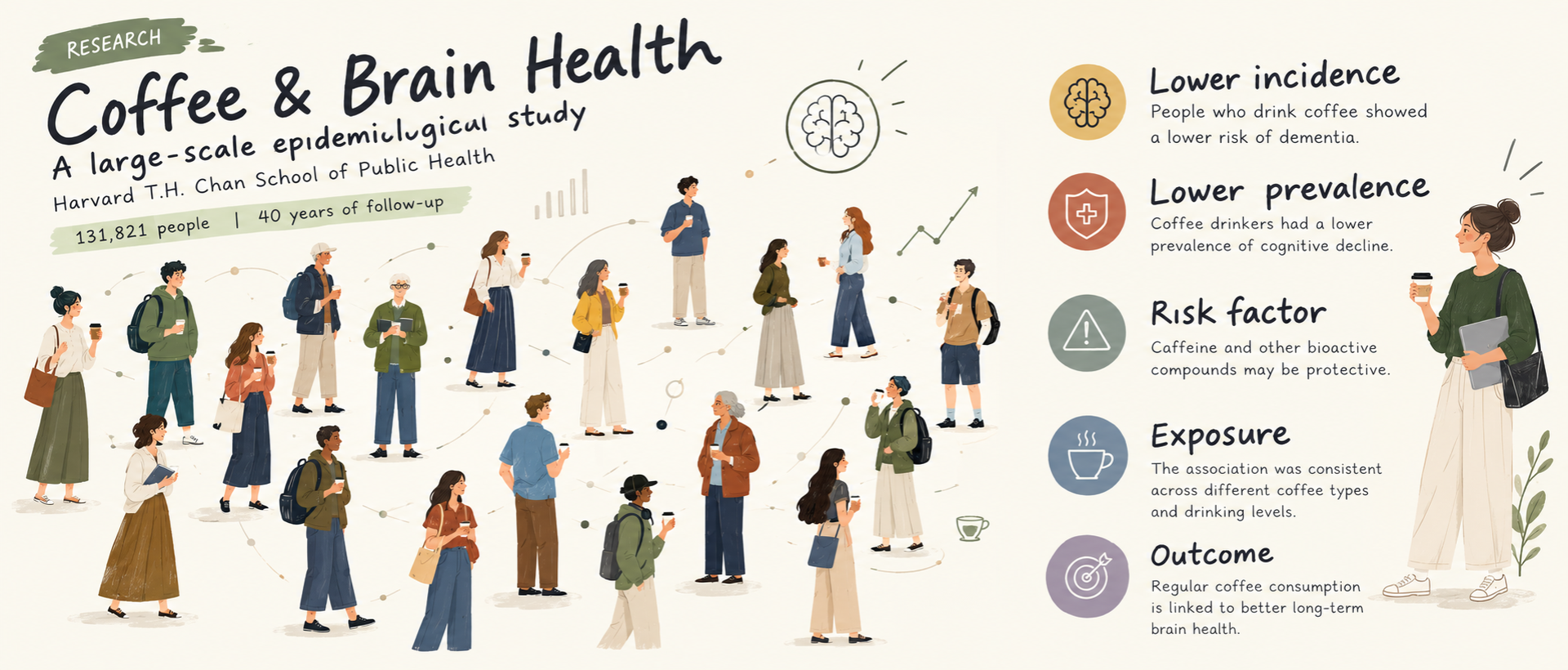
Does Coffee Really Lower Dementia Risk? What a 131,821-Person Harvard Study Found
A large Harvard study published in JAMA (Feb. 2026) followed 131,821 people for nearly 40 years and found that people who drank about 2-3 cups of caffeinated coffee per day, or 1-2 cups of tea, had the lowest dementia risk in the study. Decaffeinated coffee showed no similar protective effect. However, this is an observational study — it cannot prove cause and effect.
How Was This Study Done, and Who Took Part?
Before getting to the results, it's worth understanding how solid this study actually is. A team of Harvard researchers, led by Yu Zhang, drew on two of the most well-known long-running studies in the US: the Nurses' Health Study (86,606 women) and the Health Professionals Follow-up Study (45,215 men). Combined, that's 131,821 people, followed for an average of nearly 37 years — some for as long as 43 years.
What sets this study apart is that participants didn't just report their coffee, tea, and decaf habits once at the start. They reported again every 2 to 4 years throughout the study, giving researchers a much clearer picture of how drinking habits changed over an entire lifetime. Over that time, 11,033 participants — about 8.3% of the group — were diagnosed with dementia.
How Many Cups Are Linked to the Lowest Risk?
The pattern wasn't a straight line where more is always better. It curved: risk dropped as intake rose, up to a point, and then flattened out. That sweet spot sat at around 2-3 cups of caffeinated coffee a day (roughly 300 mg of caffeine) or 1-2 cups of caffeinated tea. Beyond that, drinking more showed no extra benefit.
The protective link also showed up more strongly in people under 75 (about a 35% relative risk reduction) than in those 75 and older (about 19%), after accounting for age, sex, smoking, alcohol use, and other health conditions.
Why Didn't Decaf Show the Same Benefit?
This is the part of the study worth sitting with a little longer. Decaf coffee showed no protective association at all, and in some analyses, people who drank more decaf actually scored slightly worse on memory tests. At first glance, that looks like bad news for decaf drinkers.
But before jumping to that conclusion, several independent experts — including Prof. Eef Hogervorst (Loughborough University) and Prof. Kevin McConway (Open University) — raise an important question: could it be that people who already had health problems, like high blood pressure, irregular heartbeat, or trouble sleeping, were the ones switching to decaf in the first place? If so, it's those underlying conditions doing the damage, not the decaf itself. Researchers call this pattern reverse causation — where the outcome quietly influences the exposure, rather than the other way around.
What Might Explain Coffee's Effect on the Brain?
If you've read Preda's earlier piece on caffeine and adenosine, you'll remember caffeine works like a "fake key" — similar enough in shape to adenosine, the molecule that makes us feel sleepy, that it slips into the same receptors in the brain without triggering drowsiness. That's what keeps us alert after a cup of coffee. Researchers behind this dementia study believe the same mechanism may extend to neurotransmitters tied to memory and learning, like dopamine and acetylcholine. Coffee's anti-inflammatory properties and its effects on brain glucose metabolism may play a role too. A separate, earlier study even found that people who drank more than 2 cups of coffee daily over a lifetime had lower levels of amyloid plaques — a hallmark of Alzheimer's disease.
It's worth noting these mechanisms come from other research — this particular study didn't test them directly.
Does This Prove Coffee Prevents Dementia?
Not yet. This is an observational study, not a randomized controlled trial, so at best it shows association — not proof that coffee causes lower dementia risk. Experts like Prof. Naveed Sattar (University of Glasgow) and Dr. Susan Kohlhaas (Alzheimer's Research UK) point out that other unmeasured factors, like overall lifestyle, diet, or cardiovascular health, could just as easily explain the pattern.
The real-world difference in risk is smaller than headlines might suggest, too. By one expert's estimate, about 12 in 100 people in the lowest-coffee group developed dementia over the follow-up period, compared with about 10 in 100 in the highest-intake group (roughly 3 cups a day on average) — a statistically real but modest gap. Dementia researchers continue to stress that not smoking, staying physically active, and managing blood pressure and blood sugar have far stronger evidence behind them than counting cups of coffee.
Preda's Take
At Preda, we've always believed accurate information matters more than an exciting headline. This research is genuinely worth following, but it shouldn't be a reason to force down more coffee in hopes of preventing disease. For us, the best cup of coffee is still the one you drink because you love how it tastes, in an amount that feels right for your own body. Long-term brain health depends mostly on the bigger picture of how you live.
Frequently Asked Questions (FAQ)
Q1. How many cups of coffee are linked to the lowest dementia risk?
About 2-3 cups of caffeinated coffee per day, or 1-2 cups of caffeinated tea, were linked to the lowest risk in this study. Drinking more didn't add extra benefit, and general guidance still caps caffeine at about 400 mg/day.
Q2. Does decaf coffee help too?
This study found no protective effect from decaf, but experts note this may reflect reverse causation — people with existing health problems often switch to decaf — rather than decaf itself being harmful to the brain.
Q3. Does this study prove coffee prevents dementia?
No. It's a large observational study of 131,821 people, not a randomized controlled trial, so it shows association, not proof of cause and effect.
Q4. How big was the actual risk reduction?
By one expert's estimate, about 12 in 100 low-coffee-intake participants developed dementia over the follow-up period, versus about 10 in 100 in the highest-intake group — a modest, though statistically significant, difference.
Q5. What reduces dementia risk more reliably than coffee?
Not smoking, regular physical activity, and controlling blood pressure and blood sugar have stronger evidence behind them than coffee or tea intake, according to dementia researchers.
A large Harvard study published in JAMA (Feb. 2026) followed 131,821 people for nearly 40 years and found that people who drank about 2-3 cups of caffeinated coffee per day, or 1-2 cups of tea, had the lowest dementia risk in the study. Decaffeinated coffee showed no similar protective effect. However, this is an observational study — it cannot prove cause and effect.
How Was This Study Done, and Who Took Part?
Before getting to the results, it's worth understanding how solid this study actually is. A team of Harvard researchers, led by Yu Zhang, drew on two of the most well-known long-running studies in the US: the Nurses' Health Study (86,606 women) and the Health Professionals Follow-up Study (45,215 men). Combined, that's 131,821 people, followed for an average of nearly 37 years — some for as long as 43 years.
What sets this study apart is that participants didn't just report their coffee, tea, and decaf habits once at the start. They reported again every 2 to 4 years throughout the study, giving researchers a much clearer picture of how drinking habits changed over an entire lifetime. Over that time, 11,033 participants — about 8.3% of the group — were diagnosed with dementia.
How Many Cups Are Linked to the Lowest Risk?
The pattern wasn't a straight line where more is always better. It curved: risk dropped as intake rose, up to a point, and then flattened out. That sweet spot sat at around 2-3 cups of caffeinated coffee a day (roughly 300 mg of caffeine) or 1-2 cups of caffeinated tea. Beyond that, drinking more showed no extra benefit.
The protective link also showed up more strongly in people under 75 (about a 35% relative risk reduction) than in those 75 and older (about 19%), after accounting for age, sex, smoking, alcohol use, and other health conditions.
Why Didn't Decaf Show the Same Benefit?
This is the part of the study worth sitting with a little longer. Decaf coffee showed no protective association at all, and in some analyses, people who drank more decaf actually scored slightly worse on memory tests. At first glance, that looks like bad news for decaf drinkers.
But before jumping to that conclusion, several independent experts — including Prof. Eef Hogervorst (Loughborough University) and Prof. Kevin McConway (Open University) — raise an important question: could it be that people who already had health problems, like high blood pressure, irregular heartbeat, or trouble sleeping, were the ones switching to decaf in the first place? If so, it's those underlying conditions doing the damage, not the decaf itself. Researchers call this pattern reverse causation — where the outcome quietly influences the exposure, rather than the other way around.
What Might Explain Coffee's Effect on the Brain?
If you've read Preda's earlier piece on caffeine and adenosine, you'll remember caffeine works like a "fake key" — similar enough in shape to adenosine, the molecule that makes us feel sleepy, that it slips into the same receptors in the brain without triggering drowsiness. That's what keeps us alert after a cup of coffee. Researchers behind this dementia study believe the same mechanism may extend to neurotransmitters tied to memory and learning, like dopamine and acetylcholine. Coffee's anti-inflammatory properties and its effects on brain glucose metabolism may play a role too. A separate, earlier study even found that people who drank more than 2 cups of coffee daily over a lifetime had lower levels of amyloid plaques — a hallmark of Alzheimer's disease.
It's worth noting these mechanisms come from other research — this particular study didn't test them directly.
Does This Prove Coffee Prevents Dementia?
Not yet. This is an observational study, not a randomized controlled trial, so at best it shows association — not proof that coffee causes lower dementia risk. Experts like Prof. Naveed Sattar (University of Glasgow) and Dr. Susan Kohlhaas (Alzheimer's Research UK) point out that other unmeasured factors, like overall lifestyle, diet, or cardiovascular health, could just as easily explain the pattern.
The real-world difference in risk is smaller than headlines might suggest, too. By one expert's estimate, about 12 in 100 people in the lowest-coffee group developed dementia over the follow-up period, compared with about 10 in 100 in the highest-intake group (roughly 3 cups a day on average) — a statistically real but modest gap. Dementia researchers continue to stress that not smoking, staying physically active, and managing blood pressure and blood sugar have far stronger evidence behind them than counting cups of coffee.
Preda's Take
At Preda, we've always believed accurate information matters more than an exciting headline. This research is genuinely worth following, but it shouldn't be a reason to force down more coffee in hopes of preventing disease. For us, the best cup of coffee is still the one you drink because you love how it tastes, in an amount that feels right for your own body. Long-term brain health depends mostly on the bigger picture of how you live.
Frequently Asked Questions (FAQ)
Q1. How many cups of coffee are linked to the lowest dementia risk?
About 2-3 cups of caffeinated coffee per day, or 1-2 cups of caffeinated tea, were linked to the lowest risk in this study. Drinking more didn't add extra benefit, and general guidance still caps caffeine at about 400 mg/day.
Q2. Does decaf coffee help too?
This study found no protective effect from decaf, but experts note this may reflect reverse causation — people with existing health problems often switch to decaf — rather than decaf itself being harmful to the brain.
Q3. Does this study prove coffee prevents dementia?
No. It's a large observational study of 131,821 people, not a randomized controlled trial, so it shows association, not proof of cause and effect.
Q4. How big was the actual risk reduction?
By one expert's estimate, about 12 in 100 low-coffee-intake participants developed dementia over the follow-up period, versus about 10 in 100 in the highest-intake group — a modest, though statistically significant, difference.
Q5. What reduces dementia risk more reliably than coffee?
Not smoking, regular physical activity, and controlling blood pressure and blood sugar have stronger evidence behind them than coffee or tea intake, according to dementia researchers.


Related Content
What the research says about coffee and blood pressure: why doctors say skip coffee before a BP check, whether daily coffee causes hypertension, and how much is safe if you already have high blood pressure.

Yes, black coffee fits a jay diet. But coffee with a meal cut plant-iron absorption by 39% in one study. Drink it 1 hour before meals instead.
A 461,586-person UK Biobank study finds 2-3 cups of coffee daily linked to the lowest risk of mood and anxiety disorders, while 5+ cups raises stress-disorder risk.
