Does Coffee Dehydrate You Before a Run?
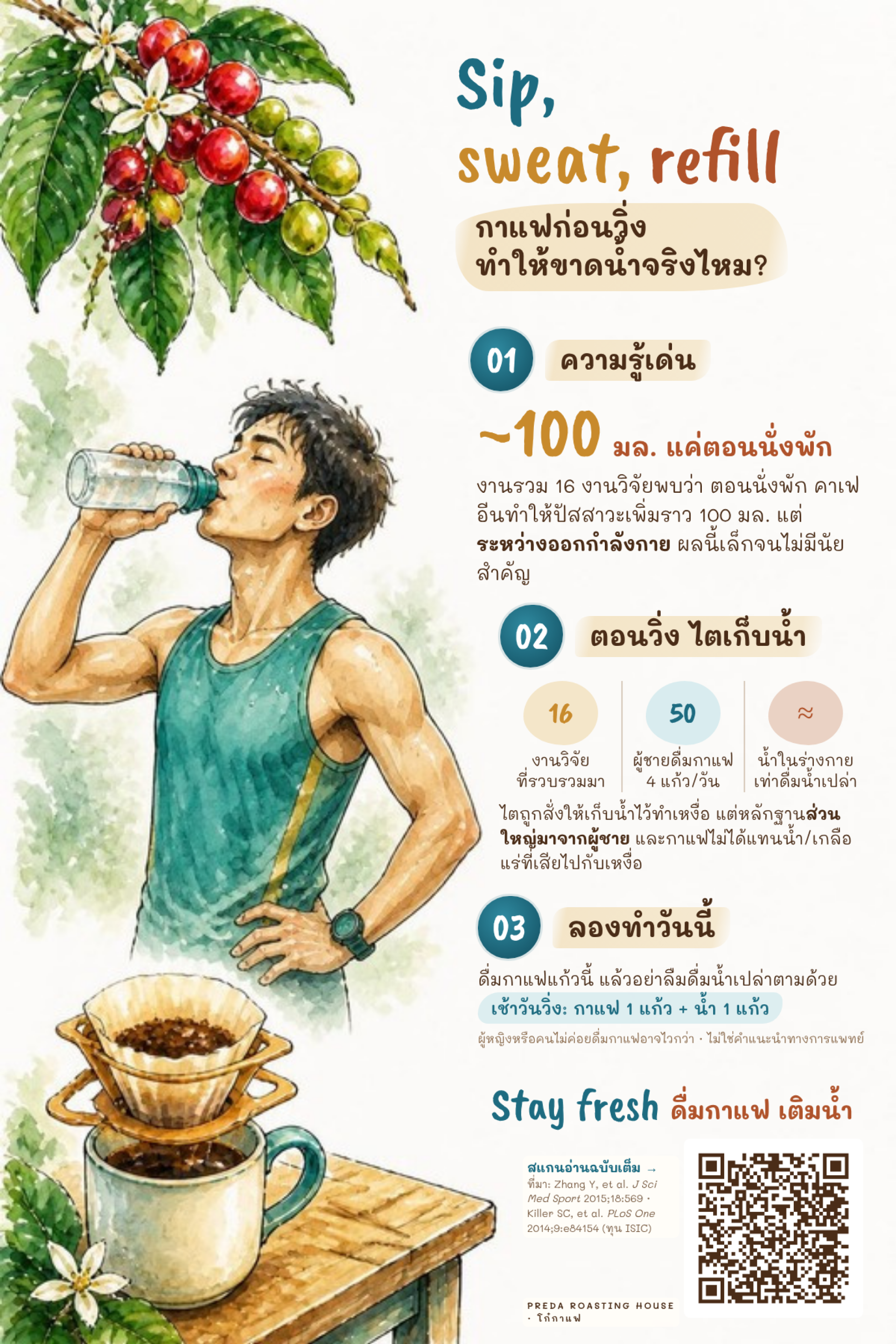
Not as much as people fear. A meta-analysis of 16 studies found caffeine adds about 109 ml of urine at rest, but during exercise the effect becomes too small to be significant, because the body tells the kidneys to save water for sweat. Moderate drip coffee counts as fluid, but doesn't replace water or electrolytes lost in sweat.
Why do people think coffee dehydrates you?
"Don't drink coffee before a run you'll get dehydrated." Many runners have heard this, and some skip their race-morning cup for fear of a mid-race bathroom stop or running dry in the final kilometres.
The belief isn't baseless: caffeine is a mild diuretic, and plenty of people notice more bathroom trips after their morning coffee. The real questions are whether the effect is big enough to dehydrate you and whether it still exists while you're running.
How much extra urine does caffeine really cause?
A meta-analysis led by Yang Zhang, published in the Journal of Science and Medicine in Sport, pooled 16 studies in healthy adults (median caffeine dose 300 mg). Overall, caffeine increased urine output by about 109 ml, or roughly 16%. But the effect was clear only at rest; during exercise it shrank to a non-significant level. The authors concluded that caffeine's minor diuretic effect is "negated by exercise."
In a University of Birmingham study by Sophie Killer and colleagues, 50 habitual coffee-drinking men drank four 200-ml cups of coffee a day, or the same amount of water, for three days each. Total body water, 24-hour urine volume and blood markers were essentially the same. A Loughborough University trial likewise found that urine output in the four hours after drinking a litre of coffee did not differ from water.
Why does coffee's diuretic effect fade during a run?
In our article on why coffee wakes you up, we described caffeine as a "fake key" that occupies the brain's adenosine receptors. The kidneys have adenosine receptors too. When caffeine blocks them, the kidneys reabsorb slightly less sodium and water consistent with the small rise in urinary sodium that Killer's team observed.
Once you start exercising, though, your body releases antidiuretic hormone and reduces blood flow to the kidneys to save water for sweating. It's like a house under a drought order: every tap is already turned down, so a fake key nudging one tap barely makes a difference. It's the same key that eases perceived effort, as described in our coffee before exercise article, and that can make a late cup disturb deep sleep.
Who should be more careful?
Most of the evidence comes from men. Zhang's meta-analysis suggested women may be more sensitive to caffeine's diuretic effect, although that comparison came from pooled data not designed to test sex differences.
Killer's study involved habitual male coffee drinkers at a moderate dose who avoided exercise throughout, had no decaf control, and was funded by the Institute for Scientific Information on Coffee, a non-profit coffee-and-health organisation. The authors note that large doses (around 500 mg or more) are known to be diuretic and that people who don't usually drink coffee may respond differently.
And coffee is not a sports drink. A 2026 review in Nutrients emphasises appropriate fluid, electrolyte and carbohydrate intake for maintaining hydration and performance. On long runs in hot, humid weather like Thailand's, you still need to replace what you sweat out.
So how should you drink coffee on a run day?
Keep it simple: one cup of drip coffee, one glass of water. Stick to the amount you're used to in training rather than upping the dose on race day. To learn how much you sweat, weigh yourself before and after a run most of the weight lost is water to replace.
At Preda Roasting House we roast coffee for home drip brewing and serve it at Goh Café. If you stop by after a morning run, remember to rehydrate too bring your own water bottle, or pick up a bottle of Singha drinking water at the café to go with your coffee.
Running the Mae Moh Half Marathon 2026? Pick up a free Coldbrew Active gel at Go+ Café Lampang
Runners in the Mae Moh Marathon 2026 (2569) can bring their race BIB to Go+ Café in Lampang on race day, Sunday 25 October 2026, and receive a free Coldbrew Active gel a cold brew coffee gel with medium-roast coffee flavour and a touch of honey lemon, developed by Go+ Café (while stocks last).
Coldbrew Active gel is made from coffee, so it contains caffeine. As this article suggests, race day is best for what your body already knows from training if you haven't tried this gel before, save it for after the finish line or your next training run, and enjoy it with a glass of water, since coffee doesn't replace the water you lose in sweat.
Frequently Asked Questions (FAQ)
Q1. Does coffee dehydrate you?
Moderate coffee intake in regular drinkers does not cause dehydration. In a trial of 50 men, four cups a day kept body water at the same level as drinking water.
Q2. Will coffee before a run make me need the toilet mid-run?
During exercise, caffeine's diuretic effect was too small to be significant in a 16-study meta-analysis. Drinking it while waiting around at rest may add a little extra urine.
Q3. Does coffee count toward daily fluid intake?
Yes, in moderate amounts. But coffee isn't a sports drink long runs in the heat still need water or electrolytes.
Q4. Who should be more cautious?
Women may be more sensitive, as may people who rarely drink coffee or take large doses (over about 500 mg). People with medical conditions should ask their doctor.
References
- Zhang Y, Coca A, Casa DJ, Antonio J, Green JM, Bishop PA. Caffeine and diuresis during rest and exercise: A meta-analysis. J Sci Med Sport 2015;18(5):56974. doi.org/10.1016/j.jsams.2014.07.017
- Killer SC, Blannin AK, Jeukendrup AE. No evidence of dehydration with moderate daily coffee intake: a counterbalanced cross-over study in a free-living population. PLoS One 2014;9(1):e84154. doi.org/10.1371/journal.pone.0084154
- Maughan RJ, et al. A randomized trial to assess the potential of different beverages to affect hydration status: development of a beverage hydration index. Am J Clin Nutr 2016;103(3):71723. doi.org/10.3945/ajcn.115.114769
- Maughan RJ, et al. Sucrose and Sodium but not Caffeine Content Influence the Retention of Beverages in Humans Under Euhydrated Conditions. Int J Sport Nutr Exerc Metab 2019;29(1):5160. doi.org/10.1123/ijsnem.2018-0047
- Suzuki K. Sports Drinks for Rehydration, Amelioration of Fatigue, and Recovery from Exertion. Nutrients 2026;18(11):1687. doi.org/10.3390/nu18111687
- Oppezzo M, Burke L. Does Caffeine Dehydrate You During Exercise? Wu Tsai Human Performance Alliance, 2024. humanperformancealliance.org
This article summarizes published research for general information and is not medical advice Preda Roasting House / Goh Café